Product Center

FusCoating Series

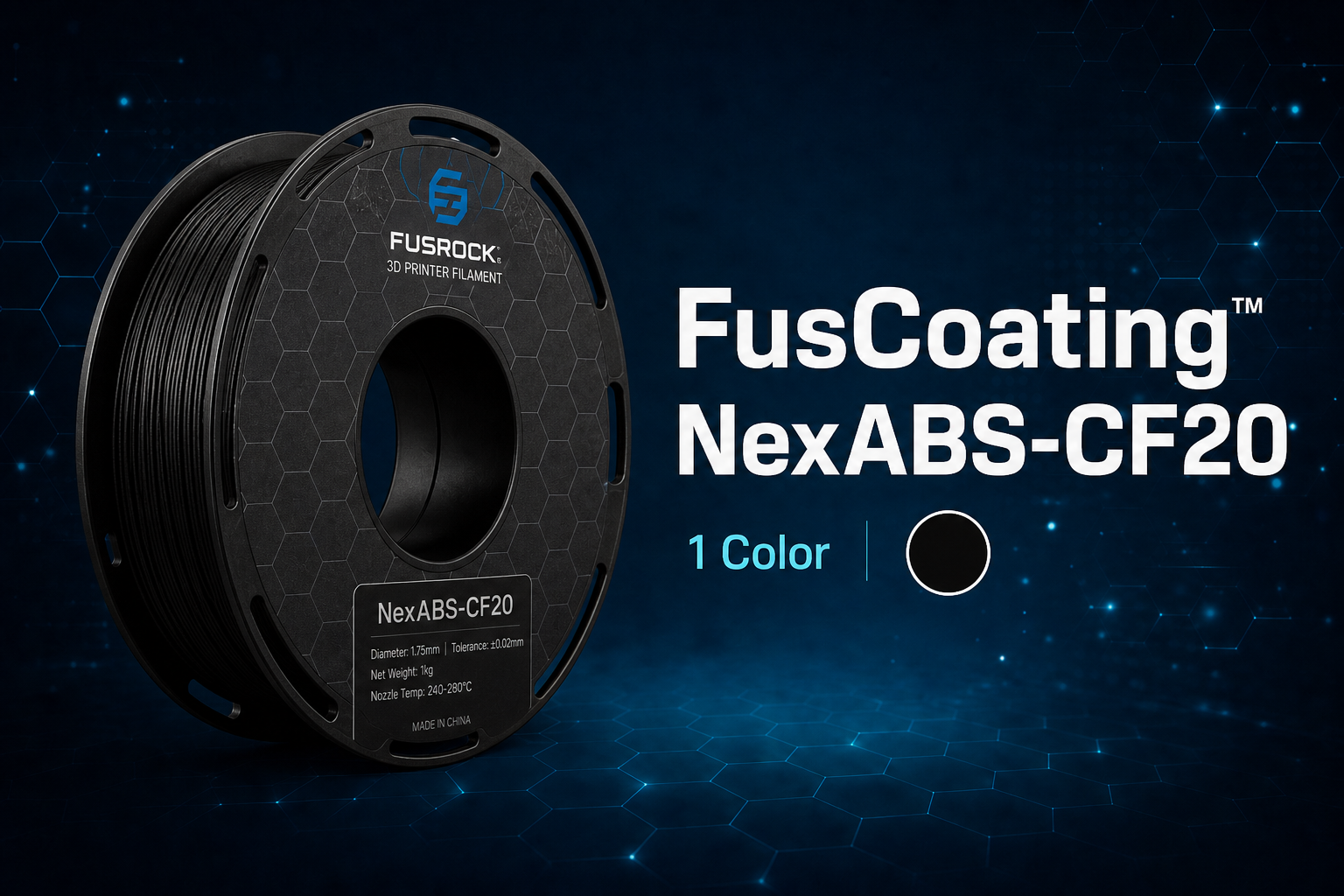
FusCoating™ NexABS-CF20

NexASA-CF20

FusCoating™ NexASA-CF20 is a carbon fiber reinforced ASA material with a skin-core structure. The inner core is ASA reinforced with 20% chopped carbon fiber, and the outer shell is unfilled ASA resin with high bond strength. The polymer fluid is always in a laminar flow state in the throat and nozzle so the skin-core structure of filaments can be maintained even after being extruded through the nozzle. This skin-core structure not only contributes to the low shrinkage, warpage resistance and ex
Unannealed83
HDT-A / degC
Unannealed9
HDT-B / degC
4606.28 Young's Modulus / MPa
- Tensile Strength / MPa
Diameter1.75mm Weight2.5kg / 3kg
Spool Info
  • Specifications
  • Print profile downloads
  • Print parameters
  • Related downloads
  • Application cases
  • FAQ
  • Health tips
  • Moisture handling & storage
  • Application disclaimer
  • Statements & copyright
PRODUCT PARAMETERS V2

FusCoating™ NexABS-CF20

Synced from Product Parameters V2: Basic & Appearance

Product Name FusCoating™ NexABS-CF20
Product Model NexABS-CF20
Forming Process FDM Compatible Filament
Color / Appearance 黑色(Black)
Package Weight 2.5 kg / 3 kg
Filament Diameter 1.75 mm
Brand FusRock
Supplier FusRock
  • Document type
  • Version
  • Time
  • Action
  • TDS
  • 5.2
  • 2025-02-01
  • No matching print profile files.

    PRODUCT PARAMETERS V2

    Print parameters

    Synced from the linked Product Parameters V2 record — use as a starting point for slicing and test prints.

    Printing Window

    Core temperature, speed and cooling settings from Product Parameters V2.

    Nozzle Temperature 250 - 280 °C
    Bed Temperature 100 - 110 °C
    Chamber Temperature 40 - 60 °C
    Print Speed 30 - 200 mm/s
    Suggested Nozzle 0.4 - 1 mm

    Hardware & Platform

    Nozzle, build plate and pre-print preparation recommendations.

    Nozzle Material Materials with hardness equal to or higher than hardened steel
    Build Plate Material PEI or Coating with PVP glue
    Enclosure Printing Please seal the cartons, raise the warehouse temperature and print.

    Support & Compatibility

    Support material, spacing and compatible material recommendations.

    Support Material FusFree™ S-Multi S-Multi · ++
    Raft Gap 0.18 - 0.2 mm
    Retraction 1 - 3 mm
    Retraction Speed 30 - 60 mm/s

    Notes

    Additional guidance maintained in Product Parameters V2.

    Other Suggestions FusCoating™ NexABS-CF20 has a higher fiber content compared with ordinary ABS-GF/CF. This technology further improves the warping resistance and rigidity of ABS materials, so the chamber temperature can be properly reduced to achieve energy saving. If the filament has been opened for a long time and problems such as air bubbles and stringing appear during the printing process, please dry the filament at 60-70°C for 4-6 hours. It is recommended to place the printer in a well-ventilated environment when printing with ABS material. FusCoating™ NexABS-CF25 can maintain a core-skin structure when extruded from the nozzle. It is based on the mechanism that the melt polymer is in a laminar state when it flows stably, However, when the printing speed is too high, the melt flow state will become unstable, and the filaments extruded from the nozzle will no longer have the skin-core structure anymore, which can cause the rough surface of the printed part. When this phenomenon occurs, it is recommended to increase the printing temperature or reduce the extrusion speed. It is recommended to use Phaetus hardened steel nozzles or nozzles with greater abrasion resistance, which can effectively improve the printing quality. The thickness of the heating block is recommended to be no less than 12mm.

    No FAQs for this product yet.

    General safety (FusRock)

    1. For intensive long-term 3D printing, use a dedicated room with adequate ventilation.
    2. If you have allergies, confirm the materials you use do not trigger a reaction.
    3. Wear a mask if you have chronic respiratory conditions; others are strongly advised to wear a mask during operation.
    4. When sanding or cutting fiber-reinforced parts, use proper PPE to avoid skin contact or inhalation.
    5. Keep printing away from children and infants.

    Spool routing & moisture control while printing

    How to route filament

    Recommended

    Use a diagram like your internal “correct feeding layout” poster (replace with image in backend):

    [Image: correct feeding path — bearing-equipped dry box + PTFE tube to the extruder]

    Use with a dry box and ensure snag-free feeding. Prefer a bearing-supported dry box and route through PTFE tubing into the hotend.

    Not recommended

    Do not casually “hang” moisture-sensitive filament outside the printer (absorbed moisture can cause stringing, failed prints or poor cosmetics).

    If you must hang a spool, check whether brackets or sheet-metal tabs interfere with the spool flange, causing extrusion drag or jams. (Add your solution link or note below.)

    [Image: tab contacting spool flange]

    Example: machine tab rubbing against spool flange

    Moisture control
    1. Refresh desiccant on schedule so the filament is not silently saturating while the hygrometer barely moves.
    2. During printing keep filament in a proper dry box. Avoid heated “dry boxes” marketed for use while actively printing if they bake the spool unevenly—they can worsen aging and trap moisture inside.
    3. When printing from AMS / AMS 2, monitor humidity badges/indicators and replace desiccant as needed.
    4. If filament picks up moisture, dry it promptly (see the Moisture treatment & storage tab).

    Storage (moisture protection)

    Short breaks Store in a sealed dry box or apply a simple vacuum pack; avoid direct sunlight.
    Long-term storage Return filament to the factory foil bag, squeeze out air (add a fresh desiccant pack if available), then place inside a household vacuum bag and pull vacuum. Keep in a cool, dry place away from sunlight.
    Drying damp filament — guidelines
    Drying parameters

    PTC compact dryer box: 60–70 °C for 4–6 hours.

    Small lab oven (forced-air): temperature uniformity is often limited; spools can warp. Reduce temperature/time (example: 40–45 °C for ~4 hours) and cross-check the material-specific drying notes in the datasheet.

    Important: if print quality does not improve, test with an empty spool before raising temperature—non-uniform heat can deform plastic flanges.

    Large forced-air oven: 60–70 °C for 4–6 hours.

    PS: Why do devices differ? Add an internal article or external link (“learn more”).

    Precautions

    Read before drying

    1. When in doubt, run an empty-spool temperature trial before increasing heat.
    2. Follow the recommended temperatures/times from the product / material admin page.
    3. Prefer forced-air ovens; do not blast the spool directly with hot air.
    4. Avoid exposing the spool edge to a violent air jet.
    5. Do not rest spools only on wire racks—use a flat heat-spreading plate if needed.
    6. Hot spools can burn—use gloves.
    7. Observe fire and electrical safety.
    8. Avoid microwave ovens or other uneven heaters; a temperature-controlled drying oven is preferred.

    (Insert “warped vs normal” spool photos here.)

    Dry vs damp

    What moisture does to prints

    DryDamp
    Cleaner surface, stable color, mechanical properties on specPitting, stringing, whitening, weaker properties (material dependent)

    (Optional: 1 / 2 / 3 day exposure at ~80% RH — same test part.)

    * Example photos may reference a specific grade (e.g. PAHT-CF); label yours accordingly.

    Contact form

    Submit